Nils Keller · 25 September 2026
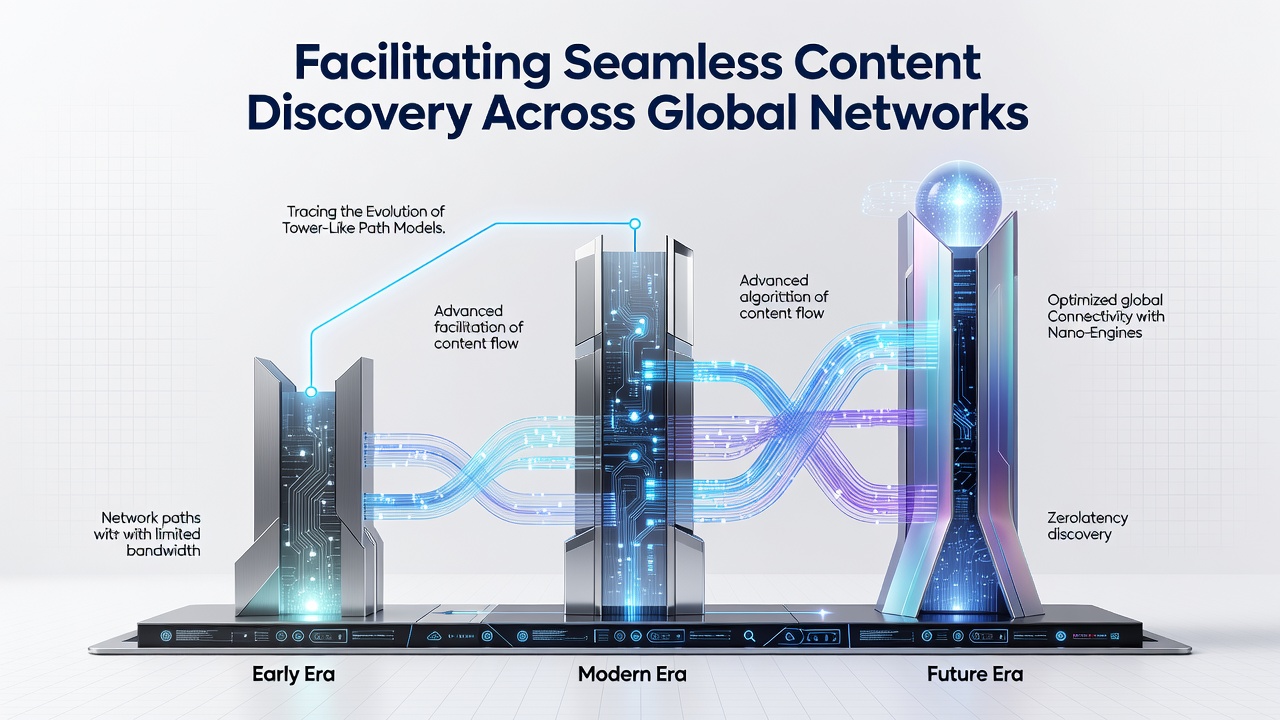
Tracing the Evolution of Tower-Like Path Models in Facilitating Seamless Content Discovery Across Global Networks
Network engineers first explored tower-like path models during the expansion of the early internet when simple linear routes proved insufficient for handling growing volumes of distributed content requests, and these structures emerged as stacked layers that organized discovery paths into vertical hierarchies while allowing horizontal connections between nodes at similar levels. Researchers documented initial implementations in the late 1980s and early 1990s when academic institutions tested multi-tier routing frameworks that reduced query latency by directing traffic through centralized towers before branching outward to edge servers, and data from those experiments showed measurable gains in retrieval speed across university networks spanning multiple continents.
Foundational Concepts in Hierarchical Routing
Tower models built upon established tree structures used in protocols like BGP yet introduced additional vertical stacking that created distinct elevation levels for path selection, and this layering enabled systems to prioritize high-volume content hubs at upper tiers while routing specialized requests downward through narrower channels. Studies conducted by international standards groups revealed that such designs handled concurrent discovery operations more effectively than flat topologies because each tower level filtered and aggregated requests before passing them along, which cut down on redundant transmissions across backbone links. Observers noted that adoption accelerated once content delivery demands surged with the rise of multimedia files in the mid-1990s, and case examples from North American research consortia illustrated how early tower prototypes integrated with existing DNS hierarchies to accelerate resolution times.
Expansion During the Broadband Era
By the early 2000s global networks incorporated tower-like models into content distribution platforms as bandwidth availability increased and user bases diversified, while engineers refined the structures to include dynamic load balancing across vertical segments. Data compiled by telecommunications authorities in Canada indicated that these adaptations supported exponential growth in video streaming traffic without proportional rises in infrastructure costs, and one documented deployment in a major urban grid demonstrated seamless failover when primary tower paths encountered congestion. The models evolved further when mobile networks entered widespread use because path towers could incorporate wireless access points at lower levels, thereby maintaining discovery continuity for devices moving between coverage zones.
Integration with Modern Global Ecosystems
Contemporary implementations combine tower-like path models with software-defined networking overlays that allow real-time reconfiguration of discovery routes, and reports from the Internet Engineering Task Force detail how these integrations improve resilience during peak global events such as large-scale content releases. IETF documentation outlines specific protocol extensions that embed tower metadata into packet headers, enabling intermediate nodes to make informed forwarding decisions without full route recomputation. As of September 2026 network operators in Asia-Pacific regions have reported deploying updated tower variants that leverage machine learning for predictive path selection, resulting in documented reductions in average discovery latency across multi-country content exchanges.

Academic investigations at European research centers have traced performance metrics across decades and found consistent patterns where tower height correlates with query volume capacity, yet optimal configurations vary by region because of differences in regulatory constraints on data routing. One analysis covering deployments in Australia highlighted how tower models adapted to strict privacy frameworks by isolating certain discovery layers, which preserved compliance while sustaining efficient content access for end users. Those who've examined cross-border implementations observe that standardized interfaces between tower levels facilitate collaboration among diverse network providers, reducing friction when content originates in one jurisdiction and is requested from another.
Technical Mechanisms Driving Efficiency
At the core of tower-like models sit algorithms that assign elevation values to network nodes based on connectivity density and content popularity, and this assignment process occurs through periodic synchronization messages that propagate upward through the structure. Engineers at industry research labs developed caching strategies that place frequently requested items at mid-tower levels for quicker lateral access, and quantitative reviews from multiple operators confirm lower overall bandwidth consumption compared with earlier mesh-based alternatives. The approach scales because additional tower segments can be inserted without disrupting existing paths, allowing gradual upgrades as global traffic patterns shift toward higher-resolution media and interactive applications.
Conclusion
Tower-like path models continue to underpin efficient content discovery by providing organized vertical frameworks that complement horizontal network expansions, and their progression reflects responses to increasing scale, diversity, and regulatory requirements across worldwide infrastructures. Evidence from ongoing deployments shows sustained utility in environments ranging from enterprise intranets to public internet backbones, with refinements expected to incorporate emerging technologies such as quantum-resistant encryption at specific tower junctions. The trajectory remains tied to measurable performance indicators tracked by standards organizations and regional authorities, ensuring adaptations stay grounded in operational data rather than theoretical projections.