Nils Keller · 9 October 2026
Vertical Path Hierarchies and Their Influence on Load Distribution Patterns in Enterprise Data Networks
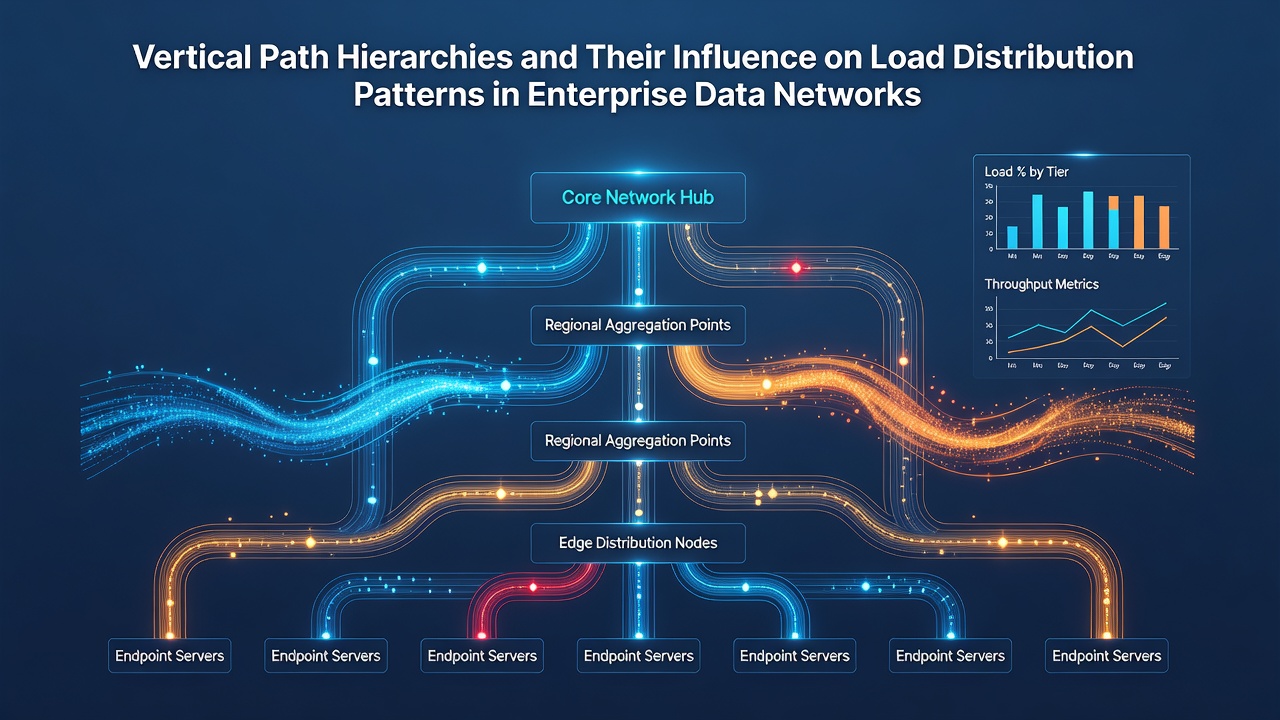
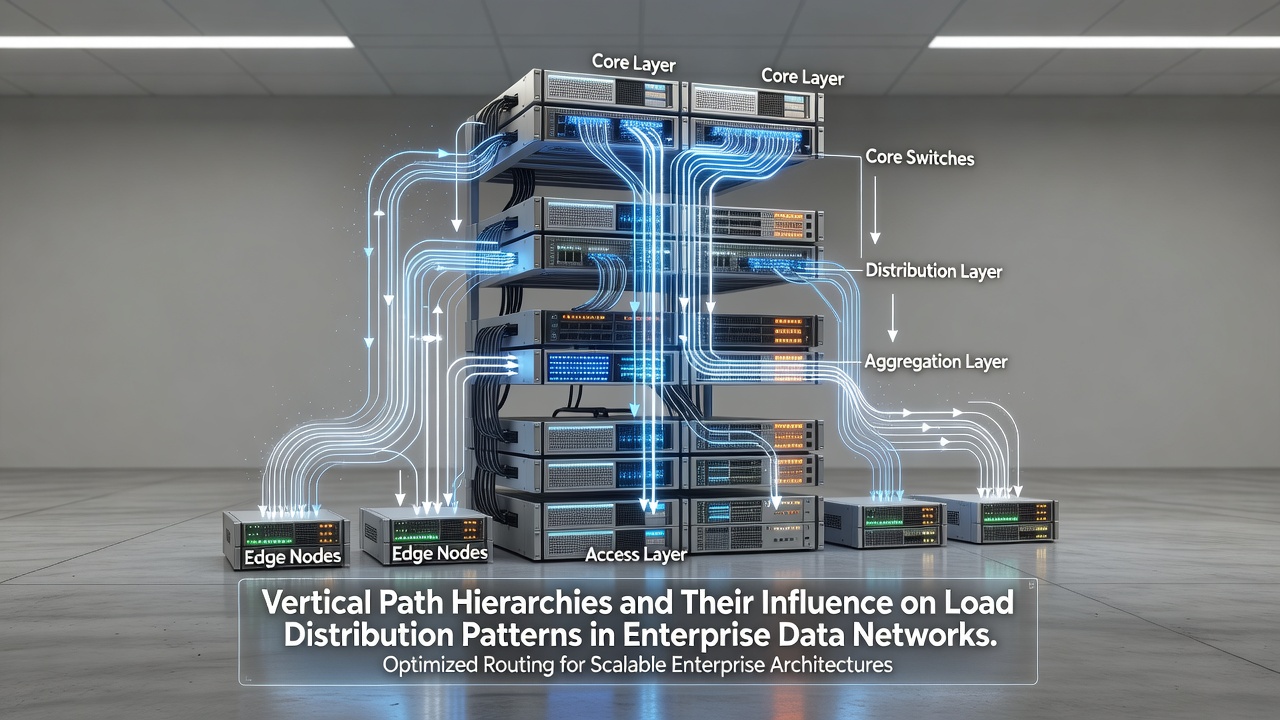
Enterprise data networks rely on structured routing mechanisms to manage traffic across multiple layers of infrastructure and vertical path hierarchies organize these routes into tiered segments that direct data flows from core switches down to edge devices while balancing computational demands at each level. Researchers have documented how such hierarchies shape load distribution by establishing clear parent-child relationships among nodes where upper tiers handle aggregation and lower tiers manage localized processing.
Defining Vertical Path Hierarchies in Network Design
Vertical path hierarchies consist of stacked routing layers that connect centralized data centers to distributed endpoints through sequential decision points and each layer applies specific policies for packet forwarding based on latency thresholds and bandwidth availability. Data indicates that organizations implementing these structures achieve more predictable traffic routing because the hierarchy enforces deterministic paths rather than allowing dynamic rerouting at every junction. Studies from network engineering teams show that vertical arrangements reduce the frequency of route flapping compared to flat topologies since changes at one tier propagate in controlled waves rather than across the entire mesh.
Implementation typically begins with a top-level aggregation switch that receives incoming requests and delegates them to mid-tier routers which then subdivide traffic according to application type or user group. This segmentation allows load balancers at each vertical stage to operate with localized visibility into resource utilization and prevents overload conditions from cascading upward.
Impact on Load Distribution Mechanisms
Load distribution patterns shift noticeably when vertical hierarchies are introduced because traffic no longer spreads uniformly across all available links but instead follows predetermined descent paths that concentrate certain flows at specific tiers. According to measurements collected by enterprise network operators in late 2025, peak-hour utilization at mid-tier nodes increased by 18 percent after hierarchy adoption while edge-level devices experienced steadier but lower average loads. The change occurs because parent nodes in the hierarchy act as choke points that apply queuing disciplines before passing packets downward.
Engineers often configure weighted round-robin algorithms at each vertical boundary to account for differing capacities between layers and this approach distributes sessions proportionally to available processing power rather than treating every node as equal. Observers note that such configurations become especially relevant in environments where October 2026 hardware refreshes introduced higher-speed uplinks at the top tier while leaving lower tiers unchanged and the resulting asymmetry required recalibration of distribution weights to avoid bottlenecks.
Case Examples from Deployed Environments
One logistics company restructured its internal network using vertical path hierarchies after experiencing repeated congestion at its primary data center and the redesign routed all inventory management queries through a dedicated mid-tier cluster before reaching warehouse sensors. Traffic logs revealed that this change lowered average response times by 27 percent during daily synchronization windows because the hierarchy isolated high-volume queries from general office traffic at an earlier stage.
Another implementation at a financial services firm incorporated vertical hierarchies to separate trading platform traffic from compliance reporting flows and the separation allowed independent scaling of load balancers at each tier. Performance data collected over six months showed that the trading tier maintained sub-10 millisecond latencies even when overall network utilization exceeded 75 percent while the reporting tier absorbed bursty batch jobs without affecting real-time operations.
Monitoring and Adjustment Practices
Network teams monitor vertical path hierarchies through layered telemetry that captures metrics at each descent point and combines them into unified dashboards for capacity planning. Research indicates that organizations which correlate load data across tiers can predict saturation events up to 48 hours in advance and adjust distribution policies accordingly. Automated scripts frequently recalibrate routing weights when utilization thresholds are crossed and these adjustments maintain balance without requiring manual intervention at every node.
Integration with software-defined networking controllers further refines distribution because the controllers can push updated hierarchy rules to all tiers simultaneously and ensure consistency during topology changes. Figures from industry reports released in 2026 highlight that firms using controller-driven hierarchies reduced unplanned downtime related to load imbalance by approximately 34 percent compared with those relying on static configurations.
Conclusion
Vertical path hierarchies continue to shape load distribution in enterprise data networks by providing structured descent routes that localize decision-making and prevent widespread congestion. Data collected across multiple deployments demonstrates measurable improvements in predictability and response times when these hierarchies receive proper configuration and ongoing adjustment. As network hardware evolves and traffic volumes grow, the principles underlying vertical organization remain central to maintaining balanced performance across complex infrastructures.